How I Made Whine-O a Wine-O: A Dad, a Baby, and a Bedtime Story About Becoming
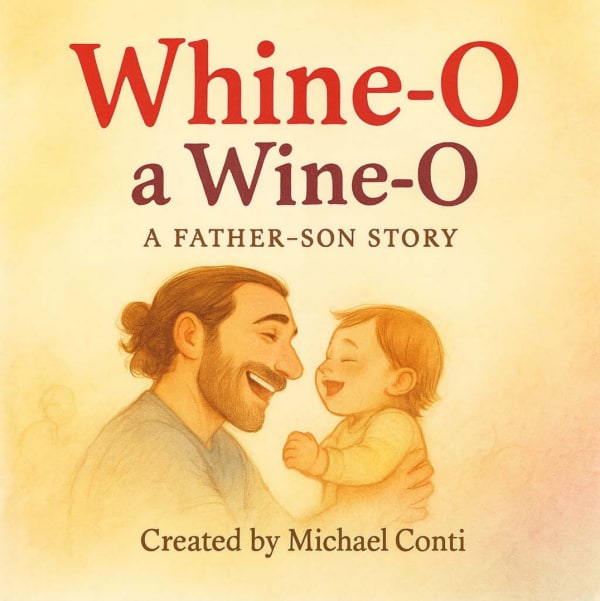
I did not set out to write a children's book.
At least, not in the way people probably imagine children's books being written — with a tidy outline, a sunny moral, and a clear sense of what the story was supposed to become.
This started much messier than that.
It started with sleep deprivation. It started with a crying baby. It started with the strange and humbling realization that becoming a father was not going to happen to me all at once, in one magical cinematic moment. It started with the disappointment I felt in myself when I realized I was not as patient, present, or naturally transformed as I had assumed I would be.
And eventually, somehow, it became a book called Whine-O a Wine-O.
The title began as a joke — a play on "mano a mano." The "Whine-O" is the baby, not because he is some one-note caricature of a whiny child, but because every new parent knows the particular sound that can turn a quiet room into a battlefield. The "Wine-O" is the father, not because he is a drunk, but because he is a man emerging from a younger, freer stage of life, where a difficult evening could once be softened by a glass of wine, a late dinner, a long conversation, or the simple luxury of sleeping in.
Then comes the baby.
And suddenly the old tools do not work anymore.
The book became my way of writing about that collision.
Before my son was born, I had a lot of ideas about what fatherhood would be like. I pictured tenderness. I pictured instinct. I pictured myself becoming calmer, wiser, and more selfless basically overnight. I thought the bond would be immediate. I thought patience would arrive naturally because love had arrived.
But the truth was more complicated.
The love was there. The bond took longer.
There were long nights where my son cried and cried, and I did not yet understand what he needed. There were moments when I tried to multitask my way through parenting (answering messages, checking my phone, getting one more thing done) only to learn the hard way that babies do not care about efficiency. They care about presence. They care about eyes. They care about rhythm and closeness and the entire human in front of them.
I learned that sleep deprivation is not a cute parenting cliché. It can turn you into someone you do not recognize. I learned that my son was not crying "for no reason"; sometimes he was hurting, like when he was struggling with silent reflux. I learned that babies do not adapt to adult schedules just because adults would like them to. I learned that the evening cannot always be stretched, because the morning is coming whether you are ready or not.
I also learned how much parenting reveals about a marriage.
My wife and I love each other deeply, but love does not exempt you from the strain of exhaustion. We had to learn how to coordinate, how to communicate, how to reset expectations, how to take care of each other while also trying to take care of a very small person who had no interest in our plans.
That became the emotional center of the book. Not just a father learning how to care for his son, but a father learning how to become present enough to receive the bond that was already forming.
The first draft of the story was not right.
At first, it was too lesson-heavy. Too neat. Too much like every spread needed to announce what the father had learned. That did not feel true to my experience. My experience was not a series of tidy lessons. It was tension, failure, exhaustion, guilt, tenderness, joy, and then, slowly, growth.
So the structure changed.
The story became an arc. The first half builds tension: false expectations, crying, sleeplessness, failed multitasking, the longing for the easier rituals of the old life. Then comes the confrontation, the "Whine-O a Wine-O" moment, not as a literal battle but as the emotional standoff between who the father was and who fatherhood is asking him to become.
The second half softens.
The father stops fighting the baby's needs. He stops trying to win. He puts down the phone. He learns the rhythm. He notices the laugh. He lets the small things become big things. And then Mom comes back into the story, not as a side character, but as part of the love that makes the whole family possible.
One of my favorite lines came near the end: This bond isn't just mine, it's a love built for two. That felt important. The story centers on fatherhood, but fatherhood does not happen in isolation. In our family, the bond between father and son grew inside a larger bond: between mother, father, and child. The book needed to honor that.
Once the manuscript started to feel right, I turned to illustration.
That opened an entirely new journey.
I wanted the art to feel warm, handmade, funny, and tender. I wanted early spreads to carry the chaos of new parenthood (coffee spilling, phones dropping, crying echoing through the room) and later spreads to become softer, calmer, more intimate. I wanted the visual language of the book to mirror the father's transformation.
At first, the illustrations were more general. Then I realized the book would mean more if the characters were inspired by my actual family. So I gathered reference photos of myself, my wife, and my son. We worked through versions of Dad, Mom, and baby until the characters felt like us without becoming stiff portraits. The goal was not photorealism. It was recognition. Warmth. A stylized family that still carried the emotional truth of the real one.
The baby came together first. Of course he did.
Dad took more work. Too dopey. Too caricatured. Too unlike the person I wanted the father to be. Eventually we found the right balance: a little tired, a little overwhelmed, but still loving, capable, and recognizably human.
Mom needed care too. She had to feel warm, graceful, grounded, and real. Not generic, not ornamental, not merely "the helper." She is part of the emotional resolution of the book.
From there, I rendered the pages one by one: the title page, dedication, each text page, each illustration page, the colophon, the back cover. Some pages came quickly. Others took many attempts. Text rendering was especially stubborn. A missing line here, a misspelled word there, an awkward line break, a final sentence that kept disappearing. There were moments when the process felt a little like parenting itself: repetitive, humbling, occasionally absurd, and weirdly rewarding when something finally clicked.
The dedication page became especially meaningful to me.
I wanted to dedicate the book to my son, of course. But I also wanted to acknowledge that this book was created with the help of AI. That felt important to say plainly. This story came from my life, my family, my feelings, my edits, my taste, my persistence. AI helped me shape it, illustrate it, and bring it into being in a way that would have been very difficult for me to do alone.
So the dedication became simpler and more personal: For my wonderful son, Cassius Wilde Conti. Love, Dad.
The process has really been a gift. It helped me understand my own experience. It gave shape to a season of life that was beautiful, difficult, and disorienting. It let me turn guilt into humor, exhaustion into rhythm, and a long, sometimes slow-forming bond into something I can hold in my hands and someday read to my son.
That is the strange magic of making something personal.
You start with a joke.
You follow it into the hard stuff.
And if you are lucky, you come out the other side with a story.
Whine-O a Wine-O is that story for me. A father and son. A cry and a glass. A standoff that becomes a bond. A little chaos. A lot of love.

Cash and me, reading Whine-O a Wine-O together.
Cash and me, reading together.