From "Whiny" to "Wǒ ài nǐ": The Story Behind Our Mother–Baby Book
Every children's book begins with a feeling.
For Wǒ ài nǐ, Whiny, that feeling was love, but not the easy, polished kind of love we sometimes imagine before becoming parents. This story grew out of the messy, beautiful, exhausting, hilarious reality of learning how to love a baby who cannot yet explain what he needs, what he feels, or how much he loves you back.
It started with a phrase: Wǒ ài nǐ. I love you.
And then, naturally, because parenthood has a sense of humor, it became: Wǒ ài nǐ, Whiny.
This book began as a companion to Whine-O a Wine-O, a father–son story about the chaos and tenderness of early parenthood. That first book explored fatherhood through the eyes of a dad learning to surrender his old routines and find meaning in the noise. But once that story existed, it felt like there was another side waiting to be told: a mother's version.
Not just a mirrored version. A softer, more inward version. A story about a mother trying to understand her child before he had the words to be understood.
The Heart of the Story
At first, the idea was simple: a baby is fussy, difficult, whiny, and Mom has to figure him out.
But the more we talked through it, the more the emotional center shifted. The story wasn't really about a "difficult" baby. It was about a baby who was already communicating, just not in the way adults expect.
Mom says "I love you" over and over again, waiting for the words to come back. But Baby cannot say them yet. He does not have the developmental ability, the vocabulary, or the language to answer in the way she hopes.
And that gap hurts.
Not because the love is missing, but because it is hidden in a different form.
The real story became this: Baby has been saying "I love you" all along: through hugs, kisses, clinging, laughter, reaching, resting his head on Mom's chest, and needing her close. Mom's journey is learning to see those actions as language.
That became the heartbeat of the book.
Love does not always arrive as words. Sometimes love is a tiny hand gripping your sleeve. Sometimes it is a sleepy head on your shoulder. Sometimes it is a giggle, a nuzzle, a kiss, or a whine that really means, "Please stay near me."
Building the Arc
Once the heart of the story was clear, we shaped it into a ten-spread children's book arc.
The emotional structure begins with expectation. Mom imagines motherhood as soft giggles, cuddles, and a simple, clear love. She pictures herself whispering "I love you" and hearing it back.
Then reality arrives. Baby communicates in wiggles, wriggles, cries, gestures, and needs that are not always easy to decode. Mom feels doubt. She wonders why the words do not come. She worries that maybe he does not understand the love she is trying so hard to give.
The turning point comes when she stops expecting love to look like language and starts observing what Baby is already doing.
A pat on the cheek. A head on her chest. A kiss. A laugh. A cling when unsure.
Those small actions become the bridge.
Then comes the breakthrough moment: Mom whispers "Wǒ ài nǐ" (Mandarin for "I love you") and Baby repeats it back.
That moment is not just about the words. It is about everything finally clicking. Mom understands him through actions, and now, suddenly, a spoken phrase connects them too. The verbal and physical languages of love meet in one beautiful moment.
From there, the book moves into harmony. Mom and Baby are not perfect, but they are more in rhythm. She understands that Baby loved her long before he could say it.
Writing the Manuscript
The manuscript was written as ten poetic stanzas, one for each spread. We wanted the language to feel tender, readable aloud, and emotionally sincere without being too heavy for a children's book.
The first spread became:
I pictured soft giggles / and cuddles each day. / A love that would blossom / in a simple, clear way. / I'd whisper, "I love you," / expecting it back — / Two hearts in perfect, / unbroken track.
From there, each spread followed the emotional progression: confusion, longing, miscommunication, observation, breakthrough, and resolution.
We also made an important creative decision: although the story is inspired by our family, we would not use Baby's name or Mom's name inside the main manuscript. That way, the book could feel universal. Any parent could read it and recognize themselves. Any child could become "Whiny."
The dedication, however, could remain personal. That is where Cash, Felicia, and Michael could be named directly. The public story stays broad; the private love remains intact.
Finding the Visual Language
Once the poem was in place, we began building the illustration direction.
The original style guide called for a watercolor and colored pencil hybrid: warm, soft, lightly textured, and emotionally focused. We wanted the art to feel timeless, cozy, and intimate, while still matching the visual world of Whine-O a Wine-O.
At first, many of the illustration ideas were emotionally right but visually too similar. Several spreads had Mom and Baby together in soft interiors, facing each other, with warm light and gentle expressions. Beautiful, but repetitive.
So we redrafted the illustration descriptions to make each spread feel distinct. One spread became a cozy evening nursery. Another became a bright morning living room. Another moved into a moonlit bedroom. Another took place in a kitchen. Another outside in a garden. Another during bath time. Another at the breakfast table. Another at a park. Another on a couch in afternoon light. And the final spread moved to a sunset porch.
That variety gave the book more visual movement. Instead of ten versions of the same emotional pose, each spread now had its own setting, palette, lighting, and rhythm.
Establishing the Characters
To keep the characters visually consistent, we selected a family-style reference image to guide the look of Mom, Baby, and Dad.
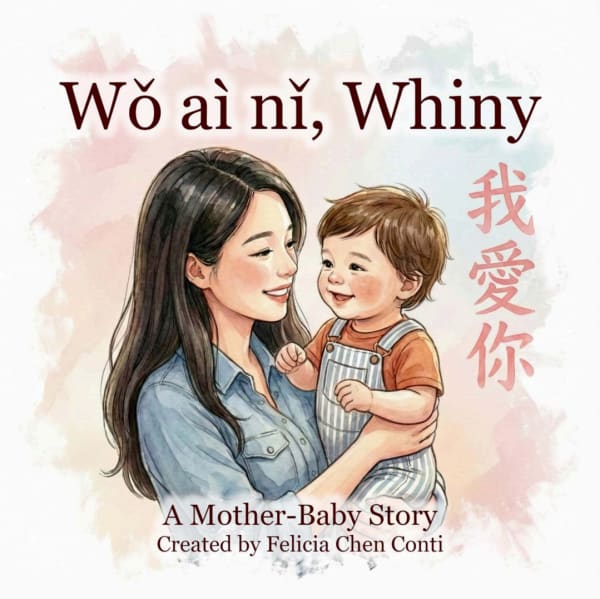
For Mom, we wanted long dark hair, warm eyes, a soft smile, and a gentle expression. For Baby, we wanted round cheeks, medium brown hair, and a joyful, expressive face. For Dad, when referenced in the broader visual world, we kept the same warm, approachable watercolor style.
The goal was not to make the book feel like a literal portrait album. It was to create lightly stylized characters inspired by real people, but still universal enough for any reader to step into.
The Cover Journey
The cover took the most iteration.
We started with a title page concept: soft blush, warm cream, pale jade, hand-drawn brown typography, and Mom holding Baby. The early versions had a quiet pencil-outline feel. Then we moved toward a fuller watercolor illustration with Mom and Baby smiling together.
We adjusted Mom's features, softened her face, made her eyes feel warmer, changed the composition, switched Mom and Baby's positions, and refined the balance of the artwork.
Then came the typography challenge. The title needed to read: Wǒ ài nǐ, Whiny. The tone marks matter. In Mandarin pinyin: Wǒ (third tone), ài (fourth tone), nǐ (third tone). But image generation tools struggled with precise diacritics. That taught us an important lesson: for final book files, typography, especially multilingual typography, needs careful, deliberate control.
We also experimented with adding the Chinese characters 我愛你 softly in the background. At first they were too faint, then too large, then partially hidden. We learned that the best path is to treat illustration and typography as separate layers. The art carries the feeling. The final design layer must carry the precision.
The Text Pages
We also developed the text pages so they would feel consistent with the art.
Each text page uses a soft watercolor wash, centered poetry, and a classic Garamond-style serif font. The backgrounds shift subtly by emotional tone: blush for expectation, pale blue for doubt, warmer tones for breakthrough, and gentle dawn colors for resolution.
This became another key part of the book's identity. The text pages are not just blank pages with words; they are quiet emotional pauses. They give each stanza room to breathe.
What the Book Became
By the end of the process, Wǒ ài nǐ, Whiny had become more than a sweet mother–baby book.
It became a story about expectation and surrender. About wanting love to come in one form, then learning it has already arrived in another. About the quiet heartbreak of waiting for words that cannot come yet. About the joy of realizing that actions were speaking all along.
It is a book for parents who have ever wondered if they are getting it right.
It is for mothers who have felt unseen in the endless work of caring. It is for fathers who know the chaos from the first book. It is for babies who love deeply before they can say so. And it is for families who understand that love is often loud, messy, physical, repetitive, and imperfect.
Sometimes it sounds like crying. Sometimes it looks like clinging. Sometimes it arrives as a kiss. Sometimes it finally becomes words.
Wǒ ài nǐ. I love you.
Looking Back
This project started as a phrase and became a full creative journey: story arc, manuscript, illustration guide, cover design, dedication page, typography experiments, text-page layouts, and production notes.
It reminded us that making a children's book is not just about writing something cute. It is about discovering the emotional truth underneath a family moment and then shaping that truth into something other families can feel too.
For us, the truth was this: A child does not have to say "I love you" for love to be present. Sometimes the parent has to learn the child's language first.
And when the words finally come, they do not create the love. They simply reveal what was already there.